

Acral Lick Dermatitis in Dogs: Why Your Dog Won't Stop Licking One Spot
A raw, hairless patch on the wrist or ankle that your dog licks every evening is a lick granuloma. Why it starts, why bitter sprays rarely fix it, and the tests that find the real cause.
· 4 min read
Updated
A lick granuloma (acral lick dermatitis) usually looks like a firm, hairless, shiny or ulcerated patch on the front of a wrist, the lower foreleg or the hock. The dog licks it in a focused, almost trance-like way, often in the evening when the house is quiet. Owners usually tell us it "started as a small spot" months ago.
It is common in Labradors, Golden Retrievers, German Shepherds and Dobermans, but any dog can develop one.
Why the licking does not stop
A lick granuloma is a cycle, not a single problem:
- Something makes the skin itch or hurt: an allergy, a small wound, a tick bite, arthritis in the joint underneath, or simply boredom.
- Licking releases endorphins, so it feels good for a moment.
- Constant moisture and friction damage hair follicles, and bacteria get deep into the skin.
- The deep infection itches and hurts, so the dog licks more.
By the time most dogs reach us, there is a deep bacterial infection under the surface. A cream or a bitter-apple spray cannot reach it.
Common triggers we look for
- Allergies: environmental allergy (atopy) and food allergy are the most frequent underlying causes.
- Pain: arthritis in the carpus or hock, an old fracture, or a nerve problem. Dogs lick over a sore joint.
- Parasites and infection: Demodex mites, fungal infection, or a foreign body such as a grass awn.
- Boredom and anxiety: a working breed left alone in a flat all day, a new baby, a house move or the loss of a companion pet.
Most dogs have more than one of these, which is why a single treatment rarely works.
What we do at the clinic
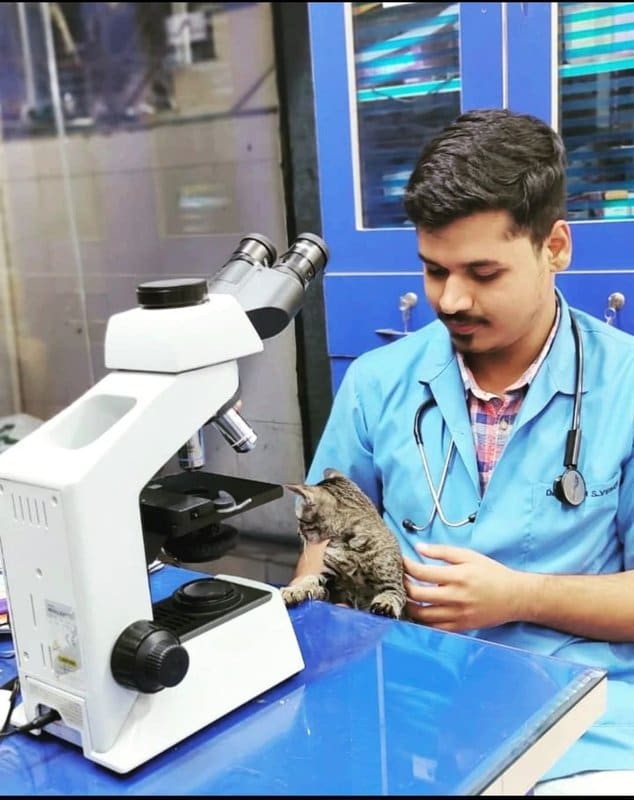
- Skin scraping and cytology in our in-house lab, to check for mites, yeast and bacteria. The slides are read during the visit.
- Culture and sensitivity if the lesion has already been through several antibiotic courses. The sample is sent to an outside lab, and it tells us which antibiotic will actually work.
- Digital X-ray of the limb if there is lameness, swelling of the bone or a long history. It rules out arthritis or a bone lesion underneath.
- A short questionnaire about routine, exercise and any changes at home.
Treatment usually has three parts
1. Clear the deep infection. Deep skin infections need a longer antibiotic course than owners expect, often 4–8 weeks, continuing about two weeks beyond the point where the skin looks healed. Stopping when the surface looks better is the commonest reason these lesions come back.
2. Break the licking. An inflatable collar, a soft cone, or a breathable sleeve or bandage while it heals. We adjust this to your dog and your home.
3. Treat the trigger. That may mean allergy management, joint pain control, or a real change in daily routine: two proper walks, sniff walks, food puzzles and chew toys. For dogs with a strong anxiety component, we may also discuss medication.
What not to do
- Don't apply human steroid or antibiotic creams. Your dog will lick them off, and steroids can make a deep infection worse.
- Don't bandage tightly at home. Tight bandages on lower legs cause swelling and pressure sores.
- Don't punish the licking. It increases stress, and stress fuels the cycle.
Frequently Asked Questions
Is a lick granuloma cancer?
Usually not, but some skin tumours can look similar. If the lesion is raised, growing quickly or not responding as expected, we take a sample (fine-needle aspirate or biopsy) to be sure.
Can it be removed surgically?
Surgery is rarely the first choice, because the skin on the lower leg is tight and the dog may simply lick the wound. We consider it only for small, stubborn lesions once the underlying cause is controlled.
Will it come back?
It can, if the trigger is still there. Dogs whose allergy or boredom is managed long term usually stay clear.
Keep reading